
Simple positioning requires hard decisions
Everyone supports simplicity until it’s time to kill their darlings

My last post argued that positioning is subtraction.
It’s a suspiciously simple idea.
Doing positioning work with a company is another matter.
I have tremendous, tremendous, tremendous respect for founders.
They start with nothing, build products, hire people & then make serious investments in growth (usually while absorbing levels of risk and uncertainty that would make most people deeply uncomfortable).
And for years, almost every sign of progress involves adding something (features, buyer segments, use cases, possibilities).
Then a positioning consultant comes along and asks, “Okay, but what matters most?”
Or worse: “What are you willing to leave out?”
This is where an idea that sounded perfectly reasonable in theory becomes much harder in practice.
Pro tip: always deliver this perspective in a tasteful, respectful, context-aware manner. You run the risk of being the punching bag if you’re telling people to kill things they’ve built that are not serving them.
I recently wrote about a founder I worked with years ago who thought positioning meant adding an adjective.
He went line by line through our product copy and told us to “position” each feature as “THE BEST”.
It’s funny now, but it’s also a perfect example of confusing the task with the work. He was changing words without making any of the decisions underneath them.
But that’s also what makes positioning difficult.
Every company should do it. Not every company is ready to live with the decisions it requires.
Early on in a project, I walk clients through a deck I call The 6 Positioning Decisions.
I made it intentionally simple.
6 decisions & 1 place to annotate/track them.
For each one, we ask:
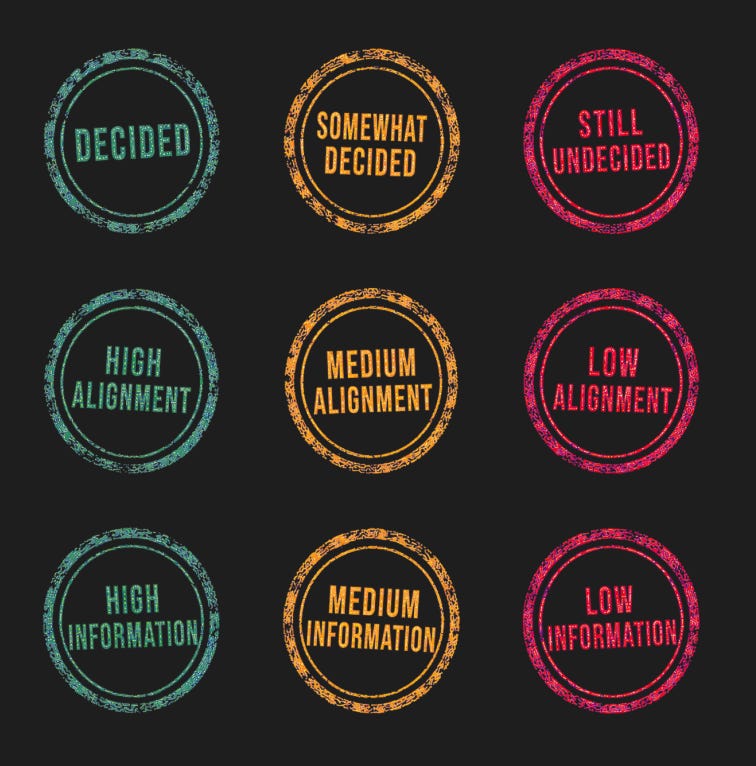
Do we have enough information?
Are the right people aligned?
Have we actually decided?
In a perfect world, every decision ends with three green stamps:

Reality is usually messier.
There are a lot of people on this email list who write copy (including me!).
Some for clients, some in-house & some as founders.
So here’s a useful question:
Have you actually reached “high information, high alignment, decided” on every positioning decision required to tell the story over and over again…enough to acquire that precious mental real estate in the mind of your buyer?
Probably not (almost nobody has).
That doesn’t mean the work stops until perfect alignment descends from the heavens.
In fact, copywriting is often where you discover whether the decisions were real.
I’ll leave you with this.
> Everyone worries about differentiation
> But most companies never reach this level of decision clarity
> If your company can make & stick to clear choices
> That alone will make you unusually different
My service carries positioning decisions through to the bottom of the funnel, where they become websites, sales decks, landing pages & sales emails.
But that isn’t where the work ends…it never ends :)
Still, you have to start somewhere.
And when the darlings inevitably return, remember what you decided.
Talk to you next week.
~Brooks